

13 Best employee engagement survey vendors and providers (2026)

Employee engagement remains a critical challenge for HR leaders across the US, UK, Europe, UAE, and APAC as organizations compete for talent and productivity. Recent Gallup data shows only about 21% of employees globally are engaged at work, while the rate in the US sits near 31%, reflecting a decade-low trend in workplace involvement.
Engagement deficits are linked to measurable business impacts, costing the global economy billions annually and increasing turnover risk. To help decision-makers from SMEs to large enterprises navigate this landscape, we reviewed 13 employee engagement survey vendors that offer tools for measuring, analyzing, and improving workforce engagement.
This guide prioritizes unbiased evaluation and practical insights over promotion to support informed vendor selection.


- Start with credibility and enterprise readiness; CultureMonkey stands out for lifecycle coverage, AI analytics, and secure role-based visibility built for scale.
- Prioritize continuous listening over annual-only surveys; Workday Peakon and Workleap Officevibe focus on real-time pulse and driver tracking.
- Compare analytics depth carefully; Qualtrics and Perceptyx offer advanced enterprise reporting and predictive insight capabilities.
- Look for strong benchmarking and science-backed models; CultureMonkey and Culture Amp are widely known for structured question frameworks and industry comparisons.
- Ensure action planning and manager workflows are embedded; Lattice, 15Five, and Quantum Workplace connect survey data to accountability and follow through.
Table of contents:
Top 13 employee engagement survey vendors
To support HR leaders and decision-makers from SMEs to large enterprises, we reviewed 13 employee engagement survey vendors based on functionality, scalability, analytics depth, pricing transparency, and real-world user feedback. The sections below present structured summaries to help you compare options and determine operational fit.
1. CultureMonkey
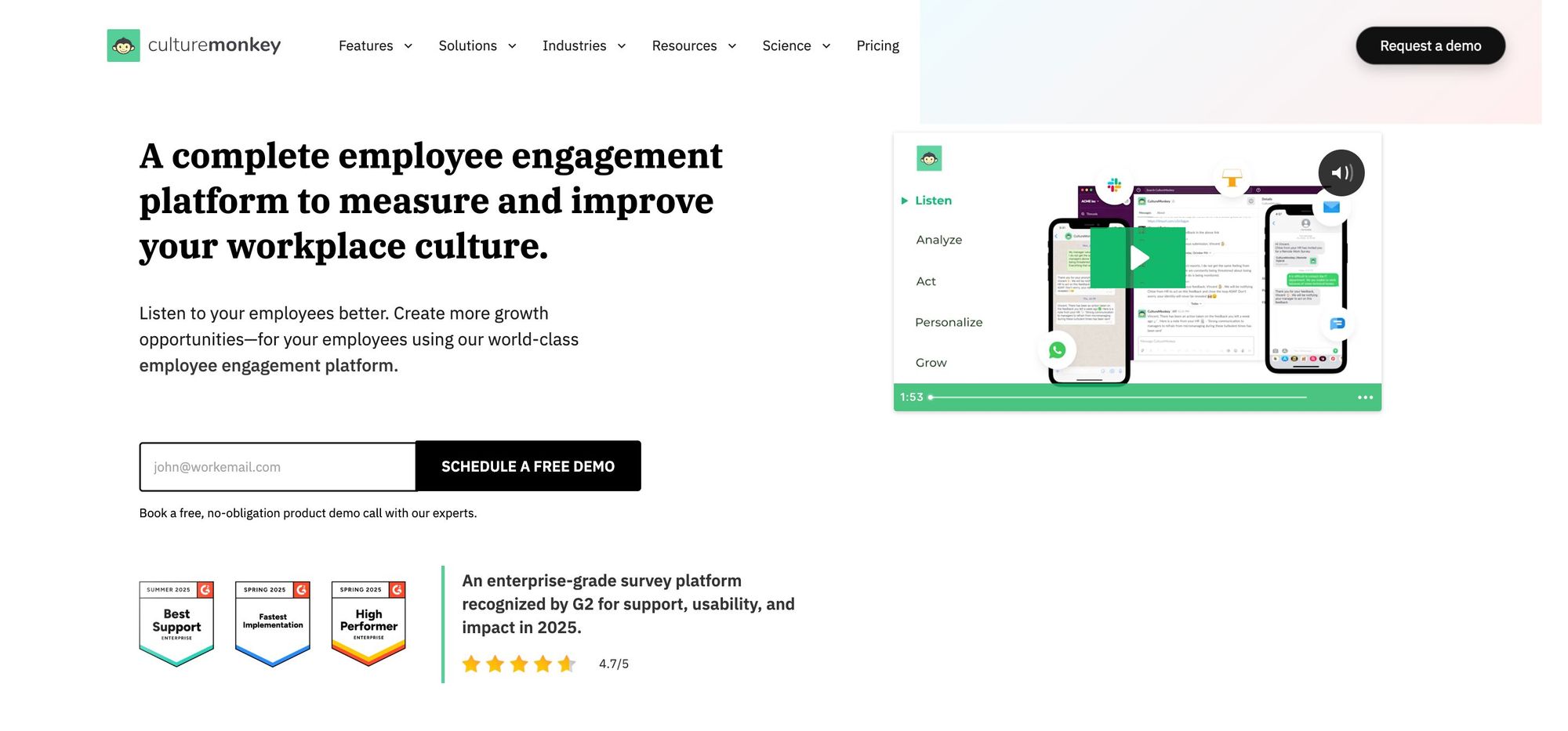





CultureMonkey is a cutting-edge, AI‑powered employee feedback tool that empowers organizations to collect, analyze, and take action on employee feedback in a holistic manner.
With our employee feedback tool, companies can enhance their workplace culture and boost employee engagement by pinpointing crucial areas for improvement and gaining actionable insights.
Here are few key features of the employee engagement platform:
Take a quick interactive tour inside CultureMonkey:

CultureMonkey overview:
Pricing: Contact sales
G2’s score: 4.7 / 5
CultureMonkey is best for: Enterprise organizations requiring multilingual, multi-channel survey distribution with structured lifecycle listening
Why we picked CultureMonkey: Brings together manager-level dashboards, real-time sentiment analytics, and HRMS integrations to enable faster interpretation and follow-through on feedback
Cons: Exporting automated, presentation-ready visual reports directly from dashboards could be more streamlined
Standout features of CultureMonkey:
- Survey distribution via WhatsApp, text messages, Microsoft Teams, Slack, email, and QR codes
- Lifecycle surveys covering onboarding, engagement, and exit stages
- Manager dashboards translating employee feedback into team-specific action insights
Learn more about CultureMonkey
2. Leapsome
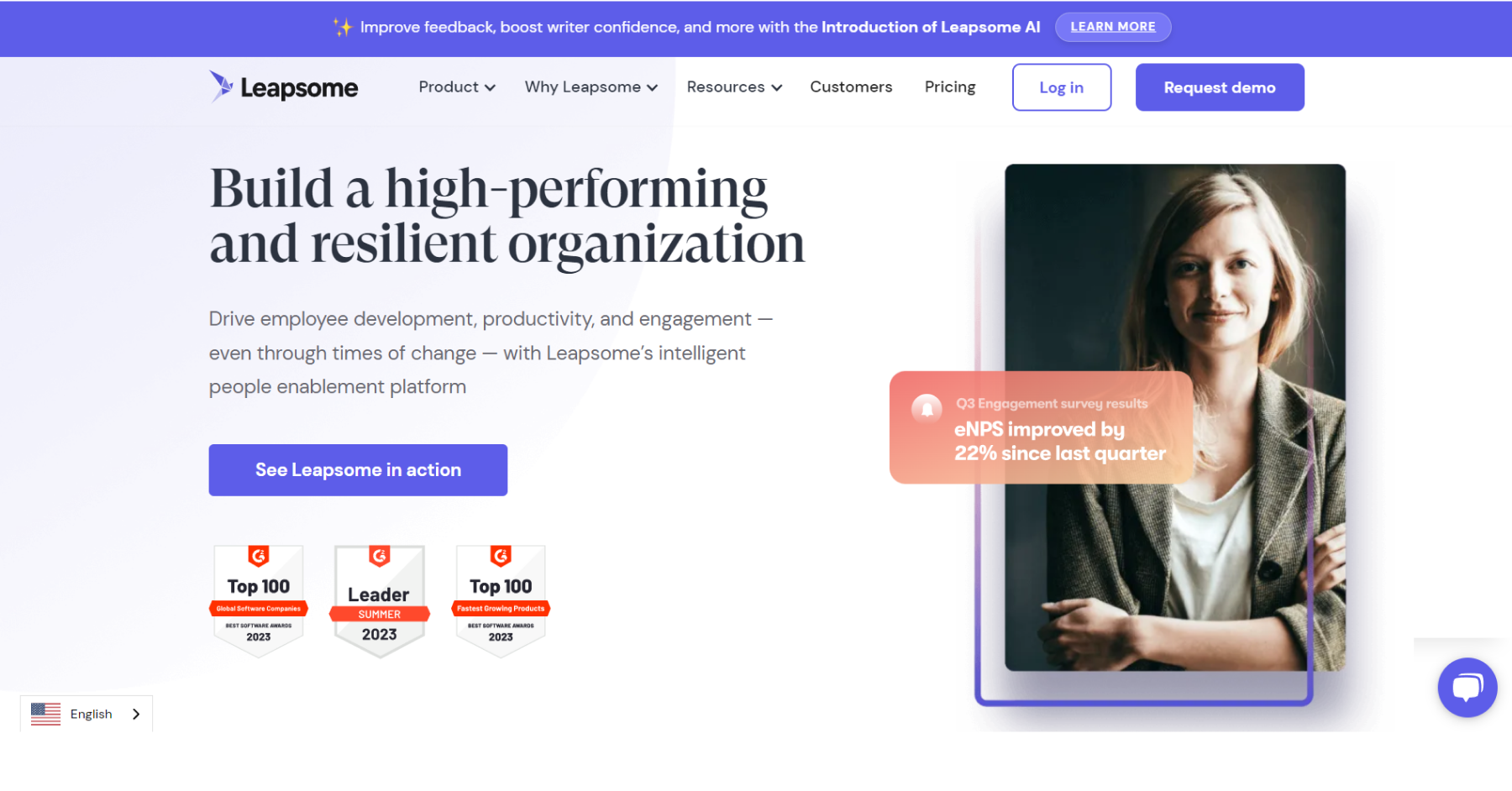
Leapsome integrates performance management with engagement surveys, allowing companies to customise questionnaires and measure employee sentiment. AI‑driven analytics help managers act on feedback and improve workplace culture.
Read: Leapsome alternatives
Leapsome overview:
Pricing: $4 per user/month
G2’s score: 4.8 / 5
Leapsome is best for: Growing companies wanting to connect performance management with engagement surveys
Why we picked Leapsome: Integrates surveys with goal tracking, performance reviews, and development plans within one platform
Cons: Managing large volumes of survey feedback can become operationally intensive
Standout features of Leapsome:
- Customizable engagement and pulse surveys
- AI-powered analytics for feedback patterns
- Integrated OKRs and performance workflows
Make every employee voice spark change
- Smart sentiment insights
- Automated feedback loops
- AI-Powered engagement trends

Find the right employee engagement survey vendor
Answer a few quick questions and get a tailored shortlist based on company size, budget, anonymity needs, AI analytics, and deployment requirements.
Results are rule-based and designed to help buyers shortlist faster.
Recommended vendors for you
Available on desktop only
This vendor selector is designed for larger screens. Open this page on a desktop or laptop to generate your tailored shortlist and downloadable recommendation summary.
3. Workday Peakon
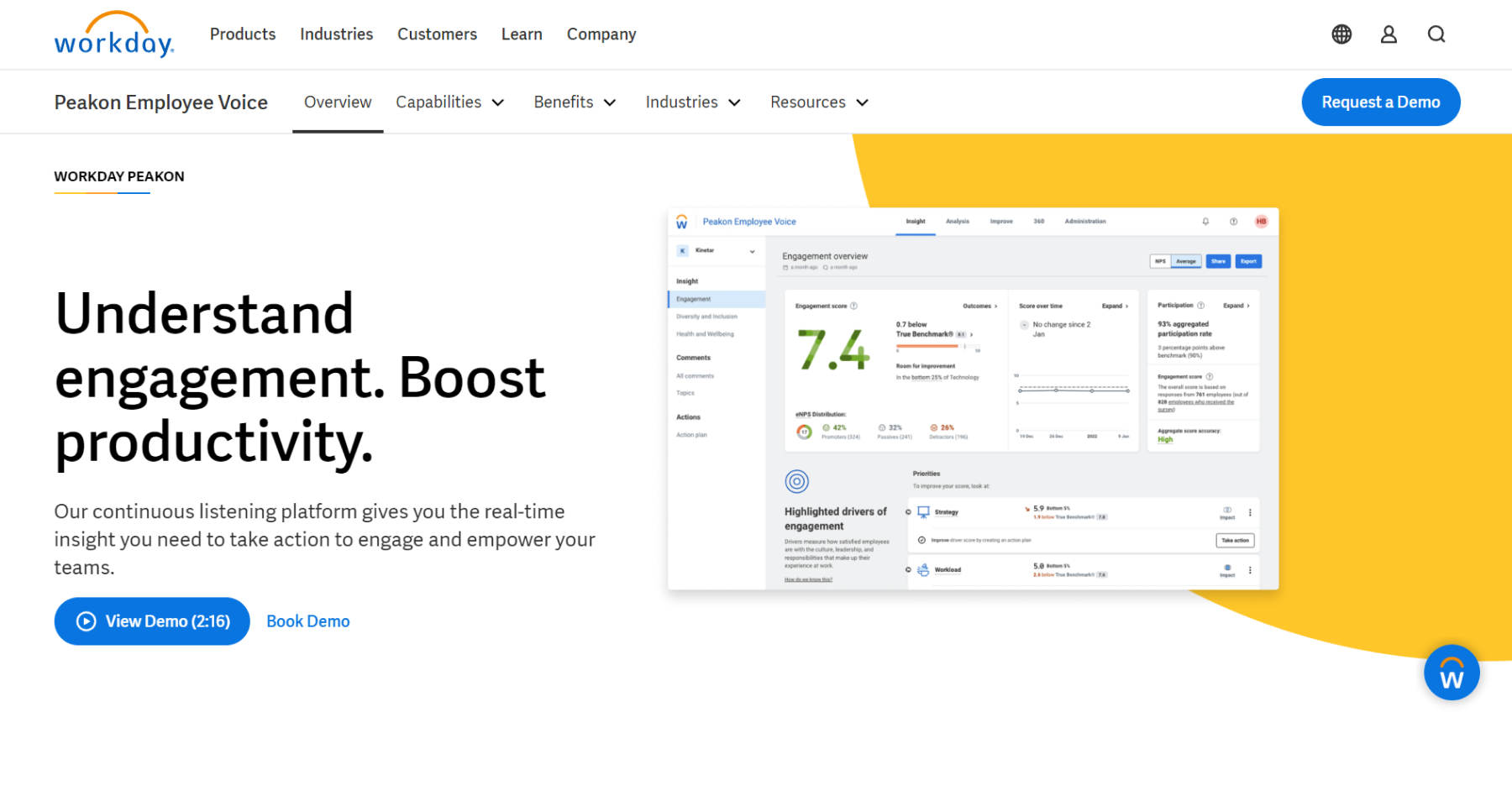
Workday Peakon is a workplace survey tool gathers continuous feedback and uses AI analytics to highlight engagement drivers. Workday Peakon helps HR teams prioritise actions and measure progress.
Read: Workday Peakon alternatives
Workday Peakon overview:
Pricing: Contact sales
G2’s score: 4.6 / 5
Workday Peakon is best for: Large enterprises already operating within the Workday ecosystem
Why we picked Workday Peakon: Offers continuous listening with AI-based driver data analysis integrated into Workday HCM
Cons: Custom styling and advanced survey customization options are limited
Standout features of Workday Peakon:
- Continuous pulse surveys
- AI-driven engagement driver identification
- Native integration with Workday HCM
4. Workleap Officevibe
Officevibe (now Workleap Officevibe) captures employee sentiment through short, anonymous pulse surveys. It provides reporting and recommendations to boost engagement and measure morale.
Read: Workleap Officevibe alternatives
Workleap Officevibe overview:
Pricing: Contact sales
G2’s score: 4.3 / 5
Workleap Officevibe is best for: Small to mid-sized teams seeking simple, anonymous pulse surveys
Why we picked Workleap Officevibe: Emphasizes frequent pulse surveys with manager-ready recommendations
Cons: Feature depth may not meet complex enterprise analytics needs
Standout features of Workleap Officevibe:
- Short, recurring pulse surveys
- Anonymous feedback mechanisms
- Manager action recommendations
5. Lattice
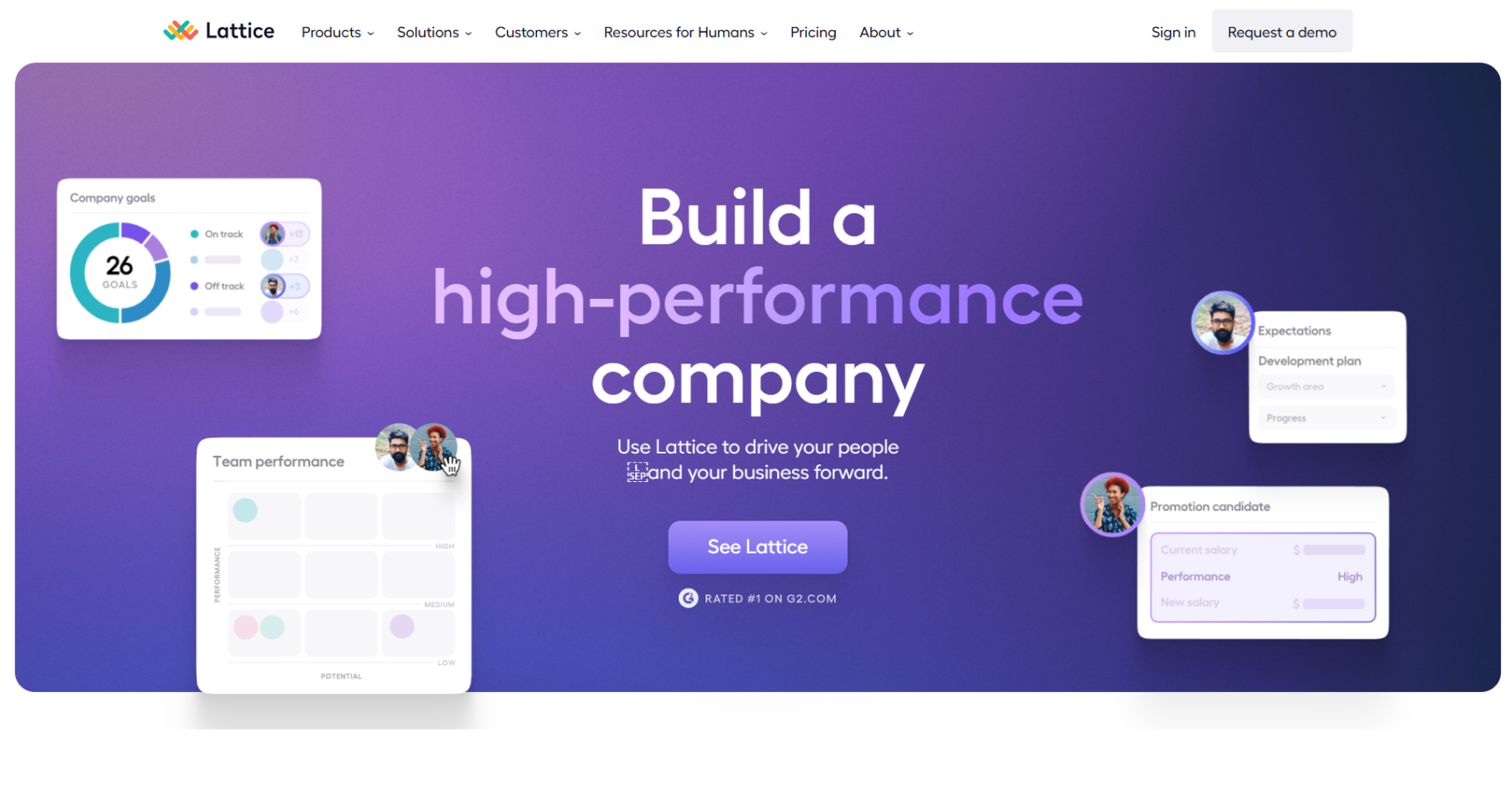
Lattice combines performance reviews with employee engagement survey software, letting organisations collect feedback and track morale. Its flexible survey builder and analytics inform talent development strategies.
Read: Lattice alternatives
Lattice overview:
Pricing: $3.50 per person/month
G2’s score: 4.7 / 5
Lattice is best for: Performance-focused organizations aligning engagement with reviews and goal tracking
Why we picked Lattice: Connects engagement surveys directly with performance management and employee development workflows
Cons: Advanced customization may require configuration support
Standout features of Lattice:
- Integrated performance and engagement surveys
- Goal tracking and OKR alignment
- Recognition and feedback tools

6. 15Five
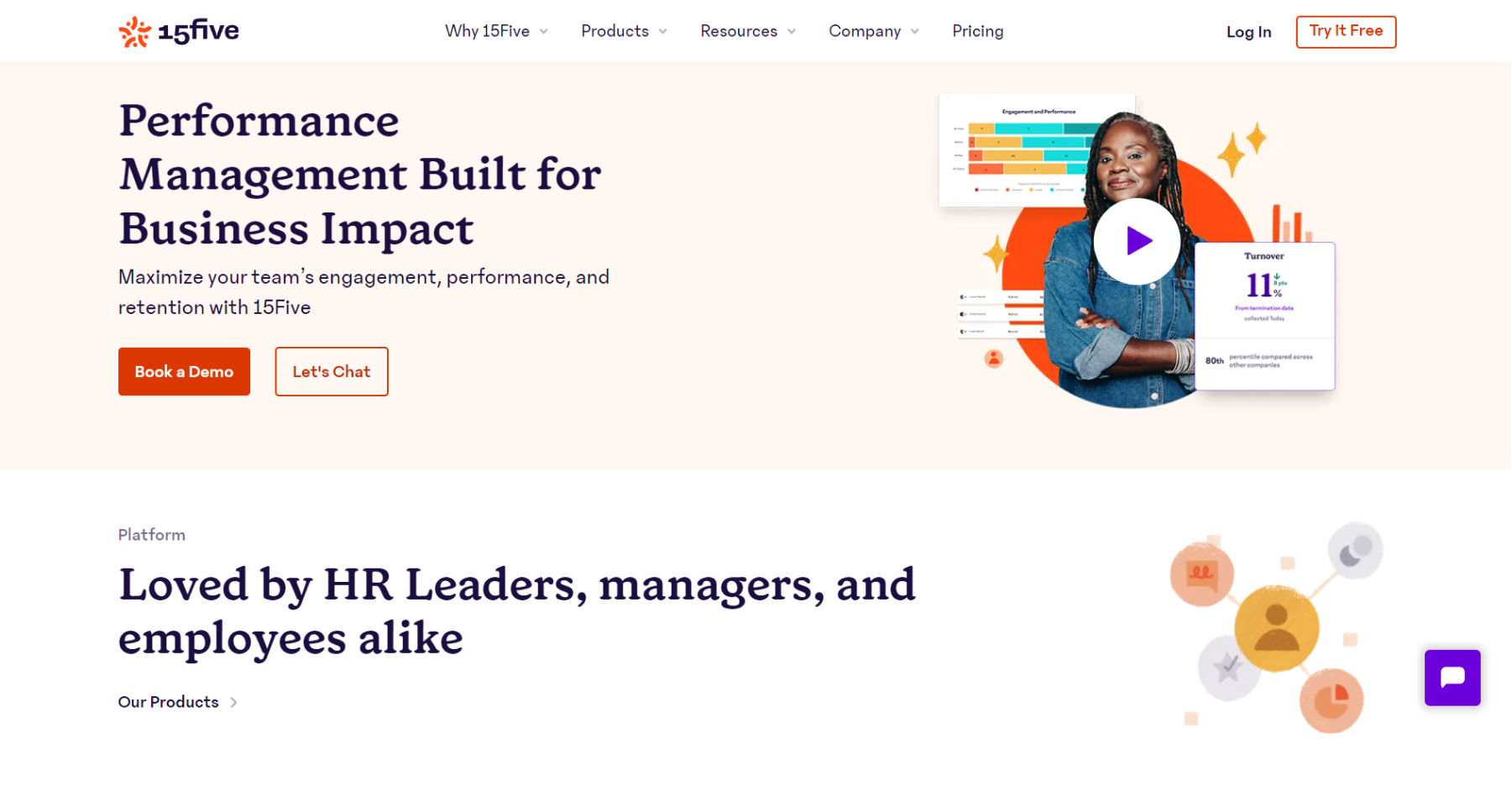
15Five uses weekly check‑ins and employee surveys to help managers understand employee sentiment. The platform’s pulse survey tools encourage continuous conversations about engagement and well‑being.
Read: 15Five alternatives
15Five overview:
Pricing: $11 per person/month
G2’s score: 4.6 / 5
15Five is best for: Teams prioritizing manager-employee check-ins alongside engagement tracking
Why we picked 15Five: Combines weekly check-ins with pulse surveys to support continuous performance conversations
Cons: Pricing may be higher for small teams needing only survey functionality
Standout features of 15Five:
- Weekly check-ins and pulse surveys
- OKR tracking
- Employee recognition tools
7. Qualtrics XM
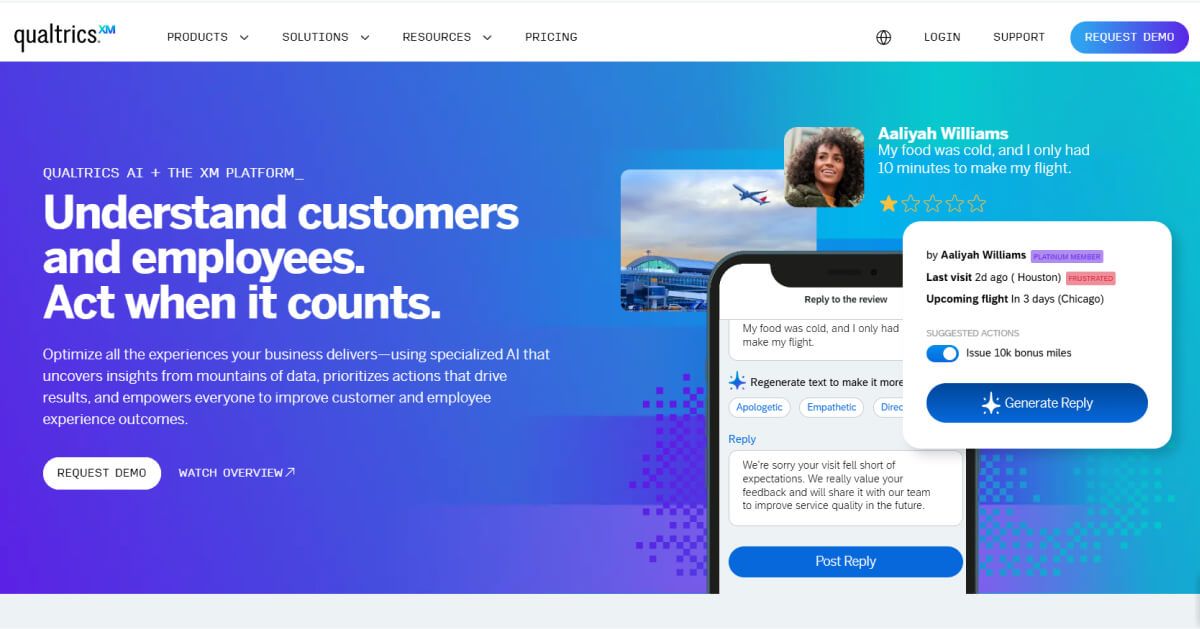
Qualtrics XM is among the employee engagement survey providers, offering robust survey design and advanced analytics. Its platform supports annual and pulse surveys to measure satisfaction and track culture change.
Read: Qualtrics XM alternatives
Qualtrics XM overview:
Pricing: $4 per user/month
G2’s score: 4.4 / 5
Qualtrics is best for: Enterprises requiring advanced survey customization and analytics depth
Why we picked Qualtrics: Offers robust survey logic, AI-driven analytics, and large-scale deployment capabilities
Cons: Feature complexity can create a learning curve for new users
Standout features of Qualtrics:
- Advanced survey design and branching
- AI-powered sentiment analysis
- Enterprise-scale deployment support
8. Microsoft Viva Glint
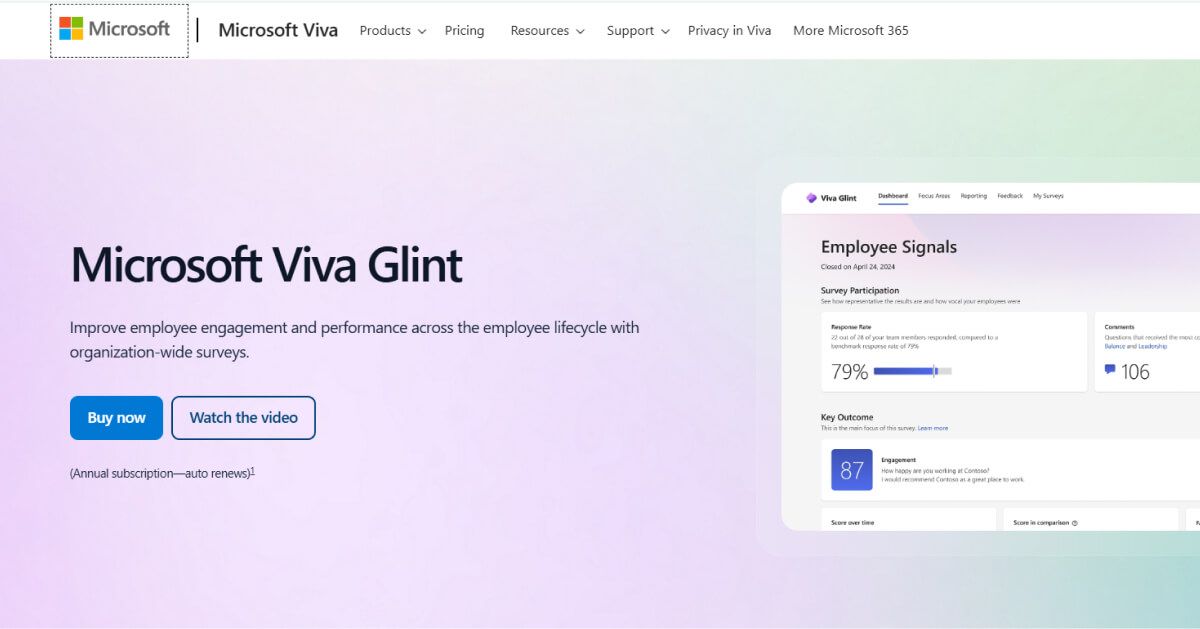
Part of Microsoft Viva, Glint delivers engagement surveys and AI‑powered analytics to help organisations understand sentiment. Real‑time dashboards assist leaders in improving engagement and well‑being.
Read: Microsoft Viva Glint alternatives
Microsoft Viva Glint overview:
Pricing: Contact sales
G2’s score: 4.6 / 5
Microsoft Viva Glint is best for: Enterprises operating heavily within the Microsoft ecosystem
Why we picked Microsoft Viva Glint: Connects engagement data with Microsoft Teams and Viva workflows
Cons: Works best within Microsoft environments and may offer limited flexibility outside it
Standout features of Microsoft Viva Glint:
- Real-time dashboards
- Integration with Microsoft Teams
- Continuous engagement tracking
9. Quantum Workplace
Quantum Workplace delivers employee engagement survey platforms including pulse and annual surveys. It uses data visualisation to reveal trends, making it a trusted employee survey provider.
Quantum Workplace overview:
Pricing: Contact sales
G2’s score: 4.4 / 5
Quantum Workplace is best for: Organizations seeking validated engagement models with benchmarking
Why we picked Quantum Workplace: Uses a scientifically validated engagement model combined with action planning tools
Cons: Admin customization controls can be restrictive
Standout features of Quantum Workplace:
- Proprietary engagement model
- Benchmarking database
- AI-supported action planning
10. Culture Amp
Culture Amp offers science‑backed employee engagement survey platforms with benchmarking and analytics. Its flexible surveys help HR leaders diagnose engagement issues and design targeted interventions.
Read: Culture Amp alternatives
Culture Amp overview:
Pricing: Contact sales
G2’s score: 4.5 / 5
Culture Amp is best for: Mid-sized to enterprise organizations seeking science-backed engagement surveys with strong benchmarking capabilities
Why we picked Culture Amp: Combines validated survey frameworks, driver analysis, and benchmarking data to help HR teams prioritize engagement initiatives
Cons: Advanced analytics and benchmarking features may require dedicated HR resources to fully utilize
Standout features of Culture Amp:
- Access to psychology-backed survey templates
- Built-in benchmarking across industries
- Driver-based engagement insights with action focus
11. Perceptyx
Perceptyx offers employee engagement survey software and consulting, delivering pulse surveys with AI‑driven insights. It helps leaders listen to employees and prioritise actions.
Perceptyx overview:
Pricing: Contact sales
G2’s score: 4.5 / 5
Perceptyx is best for: Large enterprises requiring advanced analytics and employee lifecycle insights
Why we picked Perceptyx: Provides AI-assisted action planning and in-depth engagement driver modeling
Cons: Survey length and depth may increase response fatigue if not managed
Standout features of Perceptyx:
- AI-powered feedback summarization
- Lifecycle engagement surveys
- People analytics modeling
12. WorkTango
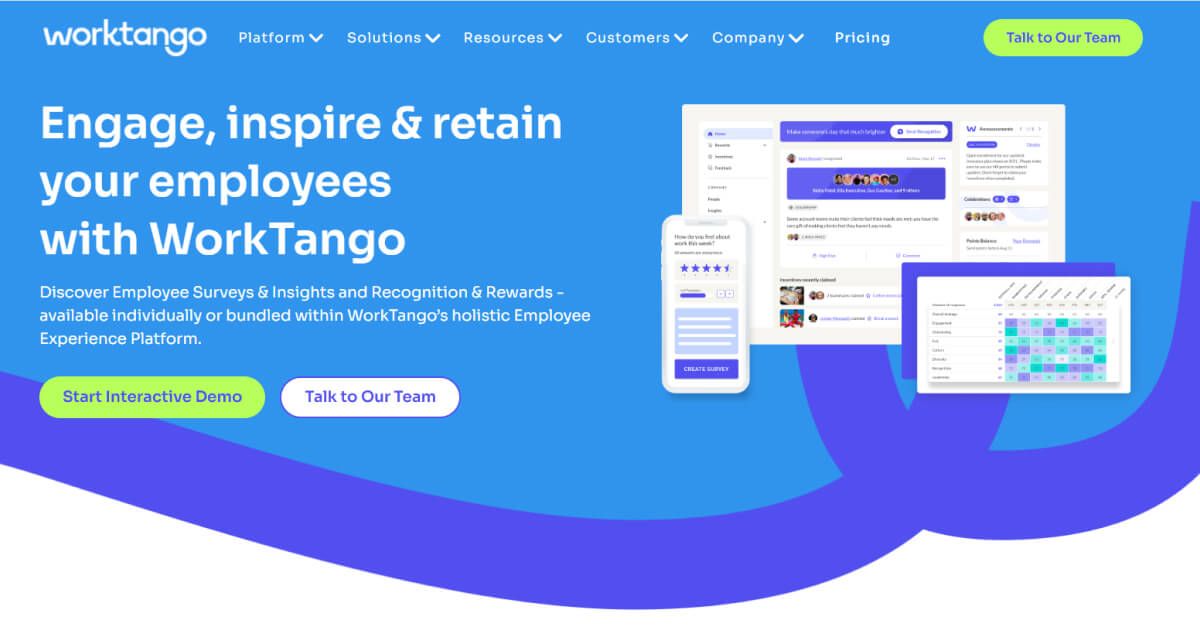
WorkTango combines engagement surveys with recognition tools, enabling continuous feedback and celebrating achievements. It assists companies in understanding sentiment and enhancing engagement.
WorkTango overview:
Pricing: Contact sales
G2’s score: 4.7 / 5
WorkTango is best for: Companies combining engagement surveys with employee recognition programs
Why we picked WorkTango: Integrates confidential feedback with recognition and performance workflows
Cons: Reporting depth may vary depending on subscription tier
Standout features of WorkTango:
- Confidential employee feedback tools
- Recognition and rewards integration
- Continuous listening capabilities
13. Zoho Survey
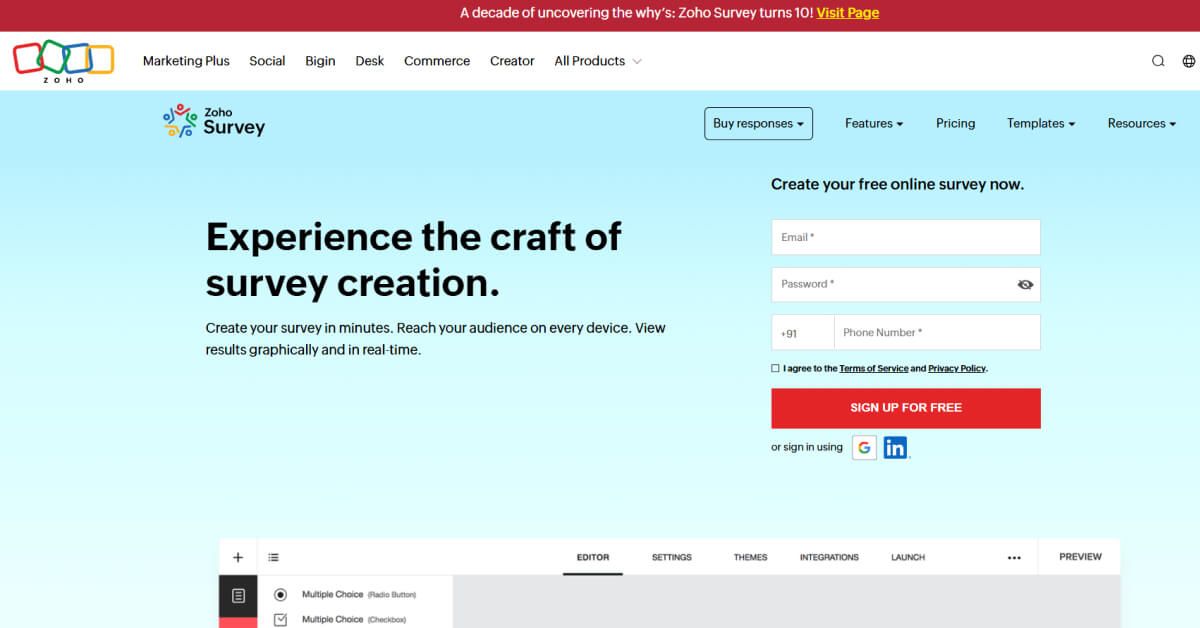
Zoho Survey offers extensive question types and customisation for creating employee satisfaction surveys. Real‑time reporting, mobile optimisation and integration with the Zoho ecosystem make it a versatile tool.
Zoho Survey overview:
Pricing: Contact sales
G2’s score: 4.4 / 5
Zoho Survey is best for: Small to mid-sized businesses seeking affordable survey deployment
Why we picked Zoho Survey: Offers straightforward survey creation with integration across the Zoho ecosystem
Cons: Advanced engagement analytics are limited compared to dedicated engagement platforms
Standout features of Zoho Survey:
- Drag-and-drop survey builder
- Integration with Zoho CRM and HR tools
- Basic reporting and analytics
Why companies trust employee engagement survey vendors in 2026
According to Gallup, companies with high employee engagement see 21% higher profitability. Beyond broad engagement scores, CultureMonkey’s longitudinal analysis of over 10 million anonymized survey responses found that Involvement (+1.51%) and Leadership (+1.50%) are the highest-growth structural multipliers, while Wellness (-0.74%) shows the largest decline in growth impact.
That’s why top enterprises increasingly turn to expert vendors for engagement insights.
So, if you are still wondering, why exactly should you ditch the DIY approach and rely on those trusty employee engagement survey vendors? Let’s break down the core benefits.
- Expertise unleashed: These survey gurus are like Sherlock Holmes meets Sigmund Freud – they know how to craft questions that reveal the deepest desires and concerns of your employees. With their expertise, you get a clear, unbiased picture of what's working and what needs a little love in your organization.
- Anonymity breeds honesty: We've all been there – hesitant to share our true feelings, fearing judgment or repercussions. But fret not! When your employees know their responses are anonymous, they're more likely to spill the tea (and not just the herbal kind). Honest feedback allows you to address issues head-on and build a culture of trust.
- Trends and comparisons: Who doesn't love a good trend analysis? These vendors provide you with invaluable data, benchmarks, and comparisons to see how you stack up against other companies. It's like peeking into your competitors' playbooks without the cloak-and-dagger drama!
- Tailored action plans: Once you've got all that data goodness, it's time to put it to work! Employee engagement survey vendors and providers don't just leave you hanging; they help create customized action plans that cater to your unique challenges and goals. It's like having a personal trainer for your company's well-being!
- Real-time pulse checks: With surveys conducted regularly, you can take the pulse of your organization in real-time. It's like having a dashboard that shows you exactly how your team's hearts are beating – steady, racing, or in dire need of a caffeine boost!
- Retention and recruitment booster: Engaged employees are more likely to stick around and even sing your praises to potential new hires. These surveys identify the key factors that keep your talent happy and loyal, making it easier to attract top-notch candidates.
- Improving the bottom line: At the end of the day, it all boils down to the numbers. Engaged employees boost productivity, reduce turnover costs, and enhance customer satisfaction – all contributing to a healthier bottom line.
Here’s what you get from an employee engagement survey provider
These offerings turn a simple survey into a strategic tool for improving retention, performance, and culture.
Tailored surveys for your unique team
These vendors are like master chefs, customizing surveys that perfectly match your company's flavors. They know that what works for a funky startup might not cut it for a more traditional corporation. So, they whip up questions that resonate with your specific culture, values, and goals.
Data, data, and more data
Once the surveys are done, you'll have a treasure trove of data at your fingertips. It's like having X-ray vision into the heart of your organization. You'll gain insights into employee satisfaction, engagement levels, and areas that need a little TLC.
Analyzing the data (So you don't have to)
Don't worry about deciphering all those graphs and charts; these experts have got your back! They'll analyze the data, spot trends, and highlight the essential takeaways, saving you from drowning in a sea of numbers.
Benchmarking for the win
It's always nice to know where you stand in the grand scheme of things. Employee engagement survey vendors offer benchmarking data, so you can see how your team stacks up against industry standards and top performers. Who doesn't love a little friendly competition?
Action plans with a side of strategy
Armed with all that valuable intel, these vendors help you whip up action plans that'll have your team dancing with joy. From addressing pain points to amplifying what's working, they'll guide you through the recipe for success.
Ongoing support and love
The survey fun doesn't end once the results are in. Employee engagement survey vendors and providers are like caring mentors, providing ongoing support and advice to keep your team on the path to greatness.
What does an employee engagement survey vendor offer: Top 7 benefits
- Data-driven insights on employee sentiment: The employee engagement vendors provide valuable insights into how employees feel about their roles, managers, and the organization as a whole. This data helps leaders understand the pulse of their workforce, guiding decisions that positively impact morale and productivity.
- Actionable feedback: Vendors offer tools to convert survey results into actionable feedback, enabling HR teams to develop targeted engagement strategies. From performance enhancement to retention plans, these insights drive meaningful changes based on real employee needs.
- Anonymous and honest feedback: Through anonymous feedback options, vendors encourage open communication without fear of judgment. This honesty leads to more accurate data on what employees truly think, allowing companies to address unspoken issues effectively.
- Benchmarking capabilities: Many vendors provide industry or role-specific benchmarks, allowing organizations to compare their engagement scores with peers. This context can help HR teams set realistic engagement goals and measure success relative to similar companies.
- Enhanced employee retention: By regularly measuring engagement, companies can identify drivers of satisfaction or dissatisfaction, helping prevent turnover. Engaged employees are more likely to stay, reducing hiring costs and maintaining organizational stability.
- Customizable and flexible surveys: Vendors typically offer customizable survey templates and question options, allowing organizations to tailor surveys to their unique culture, goals, or specific team needs. This flexibility enhances relevance and engagement with the survey process.
- Real-time analytics and reporting: Survey vendors offer real-time analytics dashboards that make data interpretation easy. Interactive reports and visualizations allow leaders to see engagement trends over time, helping track the effectiveness of engagement initiatives and guiding continuous improvements.
Best practices for partnering with employee engagement survey providers
Running surveys with an external partner? Here’s how leading HR teams make the most of their investment:
- Define clear objectives: Start by clarifying what you want to achieve from the survey. Whether it’s understanding satisfaction, identifying areas for improvement, or measuring cultural alignment, clear objectives will guide your survey design.
- Select the right vendor: Choose a vendor whose features align with your goals, such as customizable templates, analytics, and integration capabilities. A vendor experienced in your industry may also provide valuable insights.
- Customize survey questions: Work with your vendor to tailor questions that resonate with your organization's culture and specific engagement goals. Avoid generic questions to get more relevant and actionable feedback.
- Ensure data privacy and anonymity: Establish secure protocols for data collection, storage, and anonymity to build trust. Reassure employees that their responses are confidential, encouraging honest feedback.
- Set a survey frequency: Decide on the frequency of surveys, whether annual, quarterly, or pulse surveys. Regular feedback helps track changes over time, and your vendor can advise on an optimal cadence based on your needs.
- Engage leadership and managers: Gain buy-in from leaders and managers to foster support for the survey. When managers are on board, they’re more likely to encourage team participation and follow up on results.
- Communicate the survey’s purpose: Clearly communicate the survey’s purpose to employees. Emphasize that their feedback will lead to positive changes and that it’s a valuable part of shaping company culture.
- Test the survey for usability: Before launching, run a pilot survey with a small group to test for usability. Check for issues like confusing questions or technical glitches to ensure a smooth rollout.
- Promote participation: Send reminders and make it easy for employees to participate, especially for remote or frontline workers. Leverage channels like email, Slack, or SMS to reach everyone.
- Collect and analyze data in real-time: Use the vendor’s real-time feedback and analytics features to monitor responses as they come in. This enables you to promptly address any trends or issues identified.
- Share results transparently: Once data is analyzed, share key insights with employees. Transparency in results demonstrates that their input is valued and reinforces trust in the process.
- Develop action plans based on feedback: Collaborate with your vendor to develop actionable insights and recommendations. Prioritize areas for improvement and create concrete action plans that align with organizational goals.
- Follow up regularly: Implement a feedback loop to assess the impact of any changes made and gauge ongoing progress. Continue the cycle by refining the survey process and making adjustments based on employee responses and outcomes.
These best practices ensure your surveys lead to real change, not just reports collecting digital dust.
Avoid these 10 mistakes when choosing an employee engagement platform
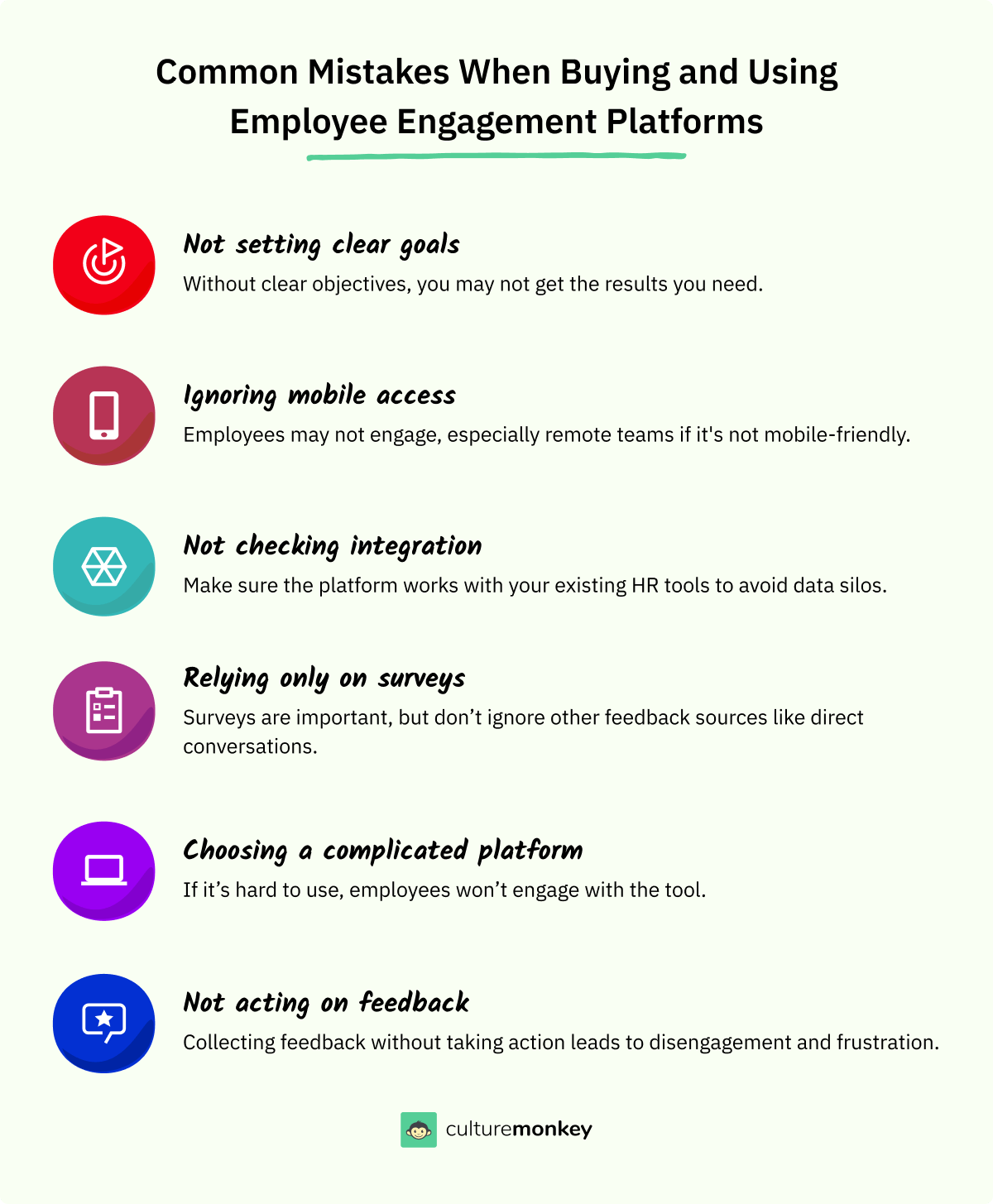
Here are 10 mistakes HR teams often make when selecting and implementing employee engagement platforms, and how to avoid them:
- Ignoring customization needs: Opting for platforms without customizable surveys can limit relevance to your specific company culture, reducing employee engagement and actionable insights.
- Neglecting data privacy: Failing to ensure data security can erode trust, especially when sensitive feedback is involved. Prioritize platforms with robust privacy features.
- Overlooking benchmarking options: Without industry benchmarks, understanding how engagement compares to competitors is difficult. Look for platforms offering comparison insights to gauge success.
- Underestimating analytics capabilities: Basic analytics don’t reveal in-depth insights. Choose a platform with advanced reporting features for actionable data.
- Skipping mobile compatibility: A platform that doesn’t work seamlessly on mobile can hinder participation, especially for remote and frontline employees.
- Using infrequent surveys: Engagement drops when surveys are limited to annual check-ins. Consider platforms with pulse survey capabilities for real-time feedback.
- Ignoring integration: If the platform doesn’t integrate with existing tools like HRIS, data may become siloed, complicating analysis and tracking.
- Failing to act on feedback: Gathering data without follow-through can worsen morale. Choose a platform that supports action planning.
- Overcomplicating surveys: Lengthy or complex surveys discourage responses. Select platforms that support clear, concise surveys.
- Lack of training: Not educating managers on interpreting survey data can render insights useless. Ensure platform providers offer resources or training for effective use.
Avoiding these mistakes can save time, boost adoption, and ensure your investment actually drives culture change.
8 Must-ask questions during employee engagement platform demos
Heading into a vendor demo? Here’s your checklist to make sure you’re asking the questions that matter
- Can surveys be customized to reflect our unique company culture? Can we tailor survey questions or design our own templates?
- What types of analytics does the platform provide? Are insights actionable, and do they include benchmarks against industry standards?
- Does the platform support pulse surveys and annual surveys? How easy is it to adjust survey frequency based on feedback needs?
- How does the platform ensure data security and anonymity? What certifications or compliance standards does it meet?
- Can this software integrate with our HRIS, performance management, and communication tools? How smooth is the integration process?
- Does the platform support action planning based on survey feedback? Are there built-in tools for tracking improvements?
- Is the platform mobile-friendly to accommodate remote and frontline employees?
- What support and training resources are available? Is there a dedicated customer success team to assist with onboarding and ongoing use?
Do employee engagement vendors offer benchmarking insights?
Yes — and it’s one of the biggest advantages of using a third-party platform.
The best employee engagement survey consultants and vendors out there can significantly aid in benchmarking results against industry standards. One of the advantages of working with a vendor is access to large datasets from similar organizations, which enables companies to compare their engagement levels with industry peers.
Employee engagement survey companies collect anonymized data across various sectors, which they then use to provide benchmarking insights. This information is invaluable for understanding how a company’s employee engagement metrics stack up, offering a contextual perspective that is difficult to obtain with in-house surveys alone.
Benchmarking against industry standards helps companies identify areas where they are excelling and those that need improvement. It allows organizations to set realistic goals, understand their competitive positioning, and even track year-over-year improvements in a meaningful way.
With vendor-provided benchmarks, companies can focus on high-impact areas that drive engagement, helping them make informed decisions. Additionally, employee survey providers can break down benchmarks by different metrics, like job role, department, or geographical region, offering a customized view that is relevant to each organization’s unique needs.
Why employee engagement surveys matter in 2026 (and beyond)
In today’s evolving workplace landscape, engagement surveys are more than HR tools, they’re strategic GPS systems. Here’s their evolving importance in 2026:
- Enhancing remote and hybrid work models: As remote and hybrid work continues, engagement surveys offer insights into employee needs, preferences, and challenges, enabling organizations to adopt policies and support systems that foster connection and productivity, regardless of location.
- Supporting mental health and wellbeing: The focus on employee wellbeing is greater than ever, with surveys providing a platform for employees to voice stressors and mental health needs. This data allows companies to implement supportive initiatives, reduce burnout, and improve work-life balance.
- Driving DEI efforts: Engagement surveys enable organizations to assess inclusivity and identify areas needing improvement, helping to create equitable environments where all employees feel valued and represented, crucial in increasingly diverse workforces.
- Improving retention rates: Regular engagement surveys help identify factors influencing employee satisfaction and turnover. With targeted interventions, companies can reduce attrition and retain talent in a competitive job market.
- Boosting innovation through feedback: Surveys encourage employees to share ideas and improvements. By valuing feedback, companies foster a culture of innovation and continuous improvement, making employees feel integral to the company’s evolution.
- Aligning employees with organizational goals: Surveys assess how well employees understand and connect with the company’s vision and goals. Insight into alignment enables leaders to reinforce messaging and adjust strategies for better alignment.
- Measuring the effectiveness of engagement initiatives: Engagement surveys provide metrics to gauge the impact of engagement initiatives. This helps organizations refine strategies, invest wisely in impactful programs, and track progress year-over-year, making engagement efforts more effective and measurable.
Advanced features CultureMonkey offers beyond surveys
CultureMonkey goes beyond basic employee survey companies, offering an entire ecosystem designed to support and elevate employee engagement throughout the entire employee journey. Here’s what makes CultureMonkey stand out:
- End-to-end engagement strategy: CultureMonkey doesn’t just collect feedback – it helps HR teams build a comprehensive engagement strategy. From survey creation to analyzing data and action planning, CultureMonkey supports every step to drive real cultural impact.
- Employee lifecycle coverage: More than just employee annual surveys or pulse surveys, CultureMonkey’s platform covers the entire employee lifecycle, from onboarding to exit. This ensures organizations can understand and act on engagement at every critical stage, proactively addressing engagement needs and improving retention.
- AI-powered Insights and predictive analytics: With AI-driven analysis, CultureMonkey highlights key trends, recurring themes, and even predicts disengagement risks, enabling HR to intervene early and retain top talent.
- Benchmarking and industry comparisons: CultureMonkey includes benchmarking tools that allow companies to see how their engagement metrics stack up against industry peers. This provides context and aids in setting realistic, impactful goals for engagement improvement.
- Personalized action planning: Going beyond feedback, CultureMonkey provides tailored action plans based on survey results, helping managers and HR professionals make informed decisions to improve team engagement and satisfaction.
- Integrated communication channels: CultureMonkey enables real-time, continuous feedback by integrating with platforms like Slack, Microsoft Teams, and WhatsApp. This feature promotes a culture of open communication and engagement.
- Comprehensive analytics dashboards: The platform offers visual and customizable dashboards that turn complex data into digestible insights. These dashboards support informed decisions with real-time data and are accessible to HR leaders and managers alike.
- Ongoing HR support and training: CultureMonkey doesn’t just provide a tool; it offers HR teams guidance on interpreting survey data, strategizing, and training for maximum impact. This includes support from engagement experts to ensure HR teams can use insights to shape a positive culture effectively.
- In-depth, customizable reporting: CultureMonkey’s reporting is fully customizable, enabling users to filter, categorize, and dive deep into employee sentiment data to understand the nuances of team morale and identify pressing issues.
- Proactive engagement recommendations: Leveraging AI, CultureMonkey doesn’t just highlight issues but also suggests actionable steps to address them. These recommendations empower HR to act promptly, building a workplace culture that resonates with employees.
Conclusion
Among several employee engagement survey vendors, CultureMonkey stands out as a top-notch choice. With its user-friendly interface, versatile survey templates, and HRMS integration, CultureMonkey simplifies the survey process and ensures valuable insights are captured effortlessly.
.webp)
Build a Culture That Listens, Backed by Science & Trust
- Enterprise-Level Compliance
- People Science Insights
- Dedicated Onboarding Support
- Multilingual Pulse Surveys
The emphasis on anonymous conversations fosters open dialogue, promoting a transparent and trusting work environment. The platform's AI-powered analysis provides deep understanding and actionable recommendations, empowering HR teams to make informed decisions for employee growth and development.
Discover the profound impact CultureMonkey can make on your organization. Elevate your employee engagement strategies and nurture a workforce that thrives on collaboration, innovation, and success.
FAQs
1. How do I evaluate the credibility of an employee engagement survey vendor?
Review client case studies, verified third party reviews, and data security certifications such as ISO 27001. Confirm GDPR compliance, benchmarking depth, and methodology transparency. A credible vendor should offer clear reporting logic, strong references, and measurable business outcomes.
2. What should I look for in the onboarding process of an engagement survey provider?
Look for structured onboarding with defined timelines, data mapping support, HRIS integrations, and manager training. Strong providers assign a customer success lead, guide survey configuration, and offer documentation and live support to ensure smooth adoption and early impact.
3. Are there employee survey vendors that specialize in enterprise level companies?
Yes. Enterprise focused vendors provide scalable infrastructure, multilingual capabilities, advanced analytics, and secure HR system integrations. They support complex org structures, global rollouts, and large data volumes while delivering role based insights for leadership and managers.
4. What’s the difference between pulse survey tools and full suite engagement platforms?
Pulse tools focus on short, frequent check-ins with lighter analytics. Full suite platforms combine pulse, lifecycle surveys, benchmarking, dashboards, and action planning. They support deeper analysis and long term strategy rather than just capturing real time sentiment.
5. Do vendors offer multilingual survey capabilities for global teams?
Many leading vendors provide multilingual survey deployment to support distributed teams across regions. This ensures inclusive participation and accurate insights. Enterprise platforms also localize dashboards and reporting to maintain cultural relevance and consistency.
6. What red flags should I watch for during vendor demos?
Be cautious of vague answers on data privacy, limited customization, unclear pricing, or missing real dashboard walkthroughs. If a vendor avoids sharing client references or post survey support plans, it may indicate gaps in long term partnership capability.
7. What makes the top employee engagement survey vendors stand out?
Top vendors differentiate through advanced analytics, clear benchmarking, and action planning tools that translate feedback into measurable outcomes. They combine usability with strong integrations and ongoing support, helping organizations move from data collection to sustained culture improvement.
8. Should I choose an annual survey vendor or a continuous listening approach?
Annual surveys support benchmarking and long term strategy, but continuous listening captures shifts in sentiment faster. Many organizations adopt a hybrid model that combines an annual baseline with regular pulse surveys to maintain visibility and responsiveness.
9. How do third party survey companies ensure unbiased employee feedback?
Third party vendors increase objectivity by ensuring anonymity, neutral question framing, and independent analysis. Employees are more likely to share honest input when handled externally, which improves response quality and gives leadership clearer insight into engagement drivers.
10. Are pulse survey vendors better than traditional engagement firms?
Pulse vendors are ideal for capturing frequent sentiment updates in fast moving environments. Traditional firms often provide deeper consulting and long term strategy. The most effective approach combines continuous pulse insights with structured analysis and action planning support.
11. How do engagement survey vendors demonstrate ROI after surveys?
Leading vendors connect engagement data with retention, productivity, and performance trends. Through benchmarking, driver analysis, and longitudinal tracking, they help quantify improvements tied to specific actions, allowing HR leaders to show measurable business impact.
12. Which vendors integrate with collaboration tools like Slack or Microsoft Teams?
Many modern engagement platforms integrate with collaboration tools to distribute surveys within daily workflows. This improves participation and reduces friction. Seamless HRIS and SSO integrations further ensure secure access and centralized employee data management.
13. Are vendor led surveys more effective than internal surveys?
Vendor led surveys typically drive higher trust because they ensure anonymity, research backed question design, and independent analysis. This encourages honest participation and delivers clearer insights. External expertise also improves action planning and long term engagement outcomes.
14. Is it better to use survey software or hire a consulting firm?
Dedicated survey platforms offer automation, scalability, and real time analytics. Consulting firms add strategic interpretation and change management expertise. Many organizations prefer platforms that combine technology with advisory support for both efficiency and impact.
15. What is the best employee engagement survey vendor?
The best vendor depends on scale, analytics depth, and support needs. Enterprise teams often compare platforms like Culture Amp for benchmarking strength and CultureMonkey for its balance of AI analytics, lifecycle coverage, frontline delivery, and guided action planning.
)